

 Written by Silas Reed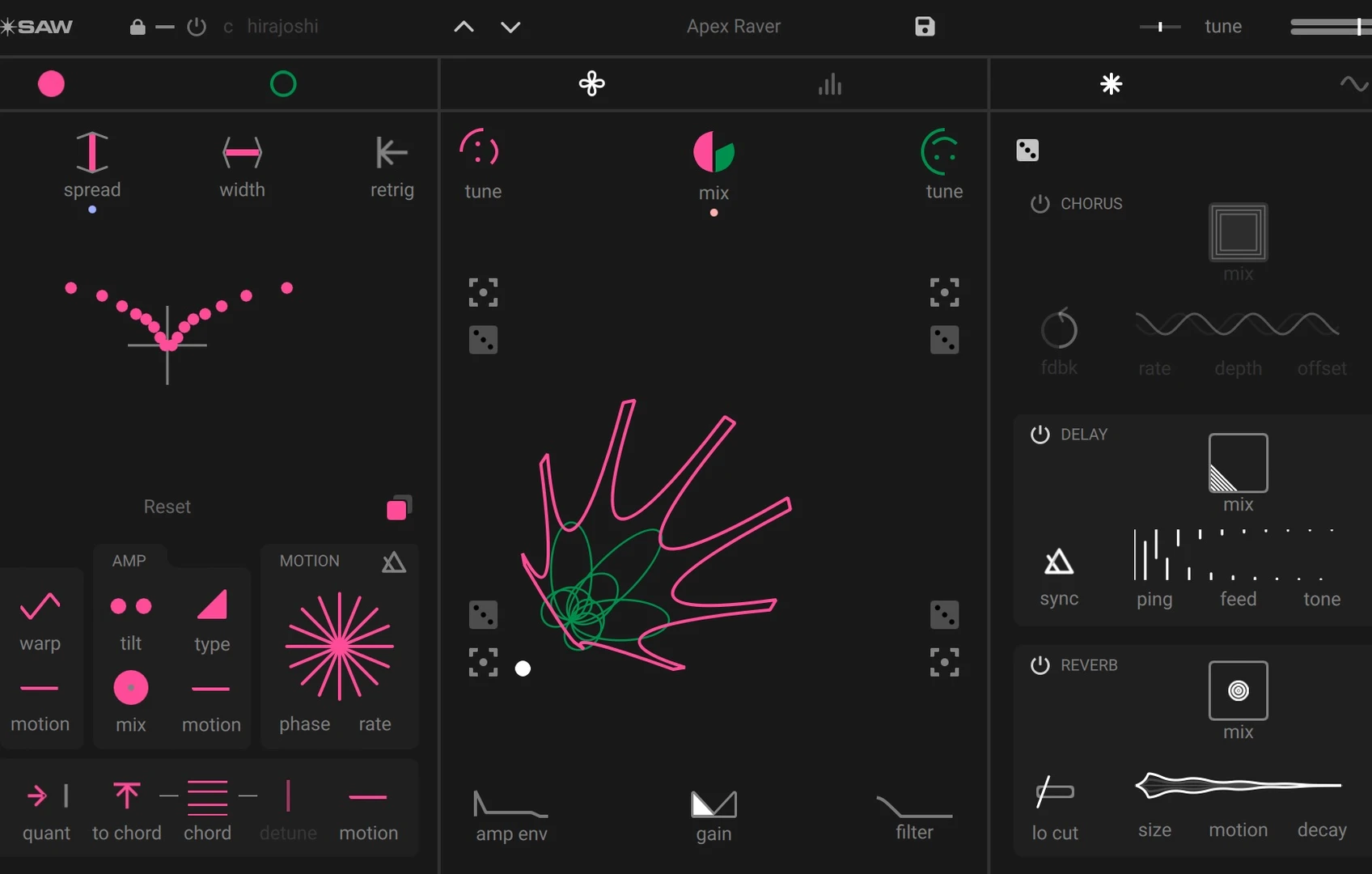
Seven teeth, one shadow
Native Instruments’ SuperStarSaw arrives carrying a name as subtle as a laser through fog. Attack Magazine’s review describes an instrument organized around two banks of stacked saw waves and a morphing system that moves among four snapshots. The obvious reading is nostalgia: cue the white-label trance record, open the filter, wait for the ceiling to evaporate.
That reading leaves most of the circuit in darkness. Supersaw names an oscillator design. A patch grows from what happens next: detuning, panning, envelopes, filtering, modulation and arrangement. SuperStarSaw is useful as a cultural flare because it drags that distinction back into view. A sound long treated as a genre uniform can become raw material again when its internal motion is exposed as something playable.
The machine inside the memory
Roland introduced the JP-8000 in 1996. As the Attack review explains, its supersaw oscillator stacked seven saw waves at different tuning offsets. Dedicated processing let the instrument generate that stack without consuming voices in the usual way. Other virtual analog synths could approximate the effect by layering oscillators or engaging unison, but their available polyphony fell as the stack grew.
The mechanism is simple enough to draw on a napkin. A sawtooth wave carries a ladder of harmonics. Place several copies close together in pitch and their phase relationships keep shifting, producing slow beating and a bright, restless edge. Pan those copies across the stereo field and the movement gains physical width. The ear hears one note surrounded by a shimmering perimeter.
Repetition turned that engineering feature into a timestamp. Huge trance leads and radiant chord stacks made the supersaw synonymous with a particular strain of electronic euphoria. The circuitry never signed an exclusivity contract. The same ingredients can feed compact house stabs, smeared pads, aggressive basses and slow-moving drones.
The swarm gets a control panel
SuperStarSaw calls its two sound sources swarms. According to the review, each can contain up to 16 saw waves, with control over wave count, tuning separation, stereo spread, per-note retriggering and oscillator panning. With both swarms available, the architecture offers as many as 32 saw waves before its global unison controls enter the picture.
Motion controls can animate spread, tuning and the stereo distribution of those waves. Most modules include randomization, while the two swarms can be copied and adjusted as related starting points. Four customizable snapshots feed a central morphing system. Conventional envelopes, LFOs, filters, dynamics and effects handle the rest of the patch.
That design treats density as a performance parameter. A chord can begin narrow and orderly, then gradually fray at the edges without relying entirely on a filter sweep. The Attack reviewer also found friction in the reviewed version, including faint view-switching buttons, important controls that were easy to overlook and no resizable interface. Those details matter in an instrument whose appeal depends on quick access to specialized controls. The review provides no CPU benchmark, so performance at the densest settings remains a host-and-session question rather than something to assume from the wave count.
Four exits from the giant chord
A supersaw becomes predictable when every control points toward maximum size. SuperStarSaw’s exposed architecture suggests several cleaner routes.
- Choose density before brightness. Begin below the maximum wave count and listen for the point where the notes stop feeling separate. A smaller stack can leave more room for vocals, drums and transient detail. Filtering can add or remove brightness later.
- Untie detune from stereo spread. These controls often rise together, yet they solve different problems. Detune governs beating and pitch blur. Spread places that movement across the field. Check a mono fold-down after widening. If the chord loses its center, reduce the spread or reinforce it with a stable layer.
- Make motion serve the arrangement. Snapshot morphing can create distinct states for different sections. Keep an early chord narrow, introduce gentle tuning motion during a build, then open the stereo field when the arrangement has space. Constant movement quickly turns animation into fog.
- Keep low frequencies deliberate. A wide, detuned stack can make the bottom of a mix feel uncertain when channels are combined. If a separate bass carries the foundation, remove unnecessary lows from the chord. For Reese-like patches, preserve a firm central component and let the rougher motion occupy the frequencies above it.
These choices apply to any synth capable of stacked oscillators. SuperStarSaw simply puts the relevant controls close enough together to make their relationships unusually visible.
The duplicate-sound argument goes nowhere
A broad modern synth can approximate many static supersaw patches. The Attack review notes online comparisons with Serum, a general-purpose instrument that can cover an enormous range of synthesis tasks. Similarity at a frozen instant says little about how a musician reaches that sound or changes it during a track.
SuperStarSaw’s argument rests on access. Wave count, detuning behavior, stereo placement and morphing sit near the center of the instrument. A general synth may produce a comparable spectrum through unison settings and a modulation matrix. The specialized design reduces the amount of routing between the idea and the result.
Its value therefore depends on working habits. Producers who reach for stacked waves occasionally may already have sufficient tools. Musicians who want to perform transitions between related swarm states could find the focused architecture faster. Interface friction can cancel that advantage, so the current version’s resizing, parameter-reset and automation behavior deserve attention before the instrument becomes part of a regular setup. The useful comparison measures setup time and control during a song, rather than whether two initialized patches can be forced into the same shape.
The genre tag comes loose
The review describes presets reaching into 1990s deep-house chord hits, Reese-like basses and hoover territory. Those references share detuned density while diverging through envelopes, pitch behavior, filtering and rhythm. They reveal how little of the supersaw’s identity actually resides in the raw oscillator stack.
Arrangement will decide how fresh it feels. Maximum settings can restore the period costume in seconds. A low wave count, restrained detuning and one slowly moving parameter can place the same mechanism inside sparse pop, ambient music or a dry club track. Even the familiar blazing lead changes character when it appears briefly rather than occupying every chorus from wall to wall.
SuperStarSaw may carry 1996 in its circuitry, but it also makes the old design legible again. The practical ending is satisfyingly mundane: check the mix in mono, reduce the stack if the vocal blurs, and save the giant flare for the bar where the drums disappear.
Comments
No comments yet.