

 Written by Silas Reed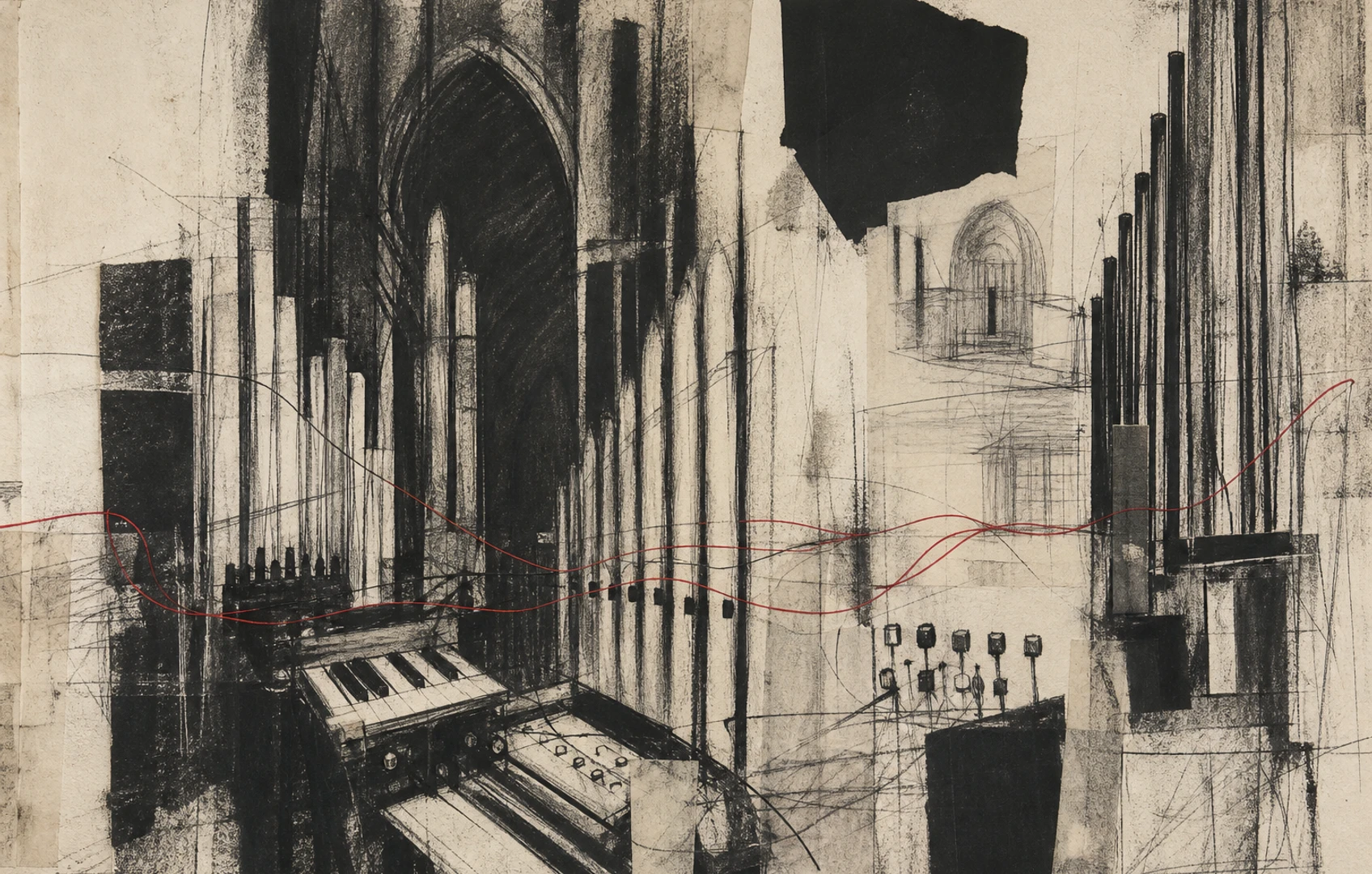
The building takes a breath
A pipe organ can make a room feel as though architecture has developed lungs. Wind moves, valves open, pipes speak, and the decay returns from stone, wood, plaster, and whatever else the building contributes. Before loudspeakers, plug-ins, or voltage control, this was already a system for assembling timbre and distributing it through space.
Sander de Keere has supplied a timely reason to hear that system with electronic ears. MusicRadar’s July 24 report describes the Belgian artist’s new composition as a meeting of minimalism, spirituality, and electronic experimentation, with the church pipe organ approached as an ancient synthesizer. The phrase is poetic, and it is technically useful. It directs attention away from ceremonial associations and toward routing, sound sources, controls, and a colossal acoustic output stage.
A patch made of air
The analogy begins at the windchest. In a typical pipe organ, pressurized air is distributed beneath groups of pipes. A key action opens a route for that air, while the selected stops determine which pipes can sound. A rank is generally a family of pipes sharing a tonal design, often with one pipe assigned to each note. A stop may control one rank, while mixtures and other designs can bring several ranks into play.
To a synth player, the logic feels recognizable. Stops select tone colors. Manuals and the pedalboard address different divisions. Couplers allow one keyboard or the pedals to call on another division. Registration, the chosen combination of stops, behaves like a patch assembled from a large, fixed set of resources.
Organ designs vary, and their actions may be mechanical, pneumatic, electrical, or mixed. The shared idea is still useful: choose sources, route control, balance spectra, and let moving air finish the job.
Registration is orchestration
An organist builds color by choosing a registration. Adding a stop can reinforce a unison, introduce an octave, bring in a reed-like edge, or stack brighter upper structure. Stop names offer clues, although their exact character depends on the instrument and its voicing. Every addition changes the spectrum and the apparent scale of the sound.
That suggests a healthy discipline for software synths and modular systems. Begin with one source. Listen to its attack, steady state, and interaction with the room. Add a second source only when you can name its job. Perhaps it supplies low weight, a narrow band of bite, or an upper octave that helps a line read at quieter playback levels.
Save those combinations as a few deliberate states. Continuous automation has its uses, but registration teaches the force of a discrete change. A passage can grow because one bright layer enters on bar nine. The listener hears the exact moment the spectrum acquires another floor.
The room is in the circuit
For a pipe organ, reverberation is present from the first note. The instrument is installed and voiced in relation to its building, and the player shapes articulation and pacing around the returning sound. A quick pattern that feels crisp at the console may gather into a cloud farther down the nave. Low notes can occupy the room long after the fingers have moved.
This is where de Keere’s minimalism and electronic experimentation make an intuitive pairing. Repeated material exposes tiny changes in registration, phase, beating, and decay. Space between events becomes active arrangement room. The physical reverberation keeps composing after each key is released.
Producers can borrow that condition without copying organ tone. Choose the reverberant space before writing the part, keep the return audible, and test the tempo against the decay. If a chord lasts four beats in the MIDI region but its tail lasts another measure, the arrangement must account for both. Solo the wet return before adding the next layer. It may already be playing the part you were about to record.
Control should have consequences
An organ console is a performance system built for simultaneous jobs. Hands can divide work across manuals, feet operate the pedalboard, and stop changes reshape the available voices. On instruments equipped with a combination action, pistons can recall prepared groups of stops. The facilities differ, but the design principle is clear: a control earns its place by producing a musically legible result.
That is a useful standard for a live electronic rig. Map controls to structural moves instead of collecting dozens of tiny options. One button might add an upper voice while trimming low buildup. A foot control might hold a drone, bring in a bass layer, or release both hands for a transition. Prepare a small number of states that can be identified by ear.
Setup friction matters here. A change hidden four menu pages deep will be hard to trust under stage light. The organ console puts its important decisions within reach, including the ones performed while a bass note continues under the player’s shoe.
Keep the metaphor honest
The phrase ancient synthesizer is a productive shortcut. The organ family reaches back to antiquity, while the church pipe organ reflects many later centuries of mechanical, acoustic, and electrical development. Its sound sources are physical pipes, with flue and reed families speaking through different mechanisms. Tuning, voicing, air supply, and the building all influence the result.
A contemporary synth can offer continuous modulation and exact patch recall that many pipe organs cannot. Many conventional organ keyboards also lack piano-style velocity control over each note’s loudness. Dynamics emerge through registration, expression systems where available, articulation, density, and the room.
These constraints deserve respect because they prevent the analogy from turning the organ into an oversized preset. Copy the same stop list to another instrument and the result may differ in attack, balance, brightness, and weight. Site specificity is part of the instrument’s identity, down to how a final chord hangs near the ceiling.
Build an organ-minded patch
The experiment can start with any subtractive or wavetable synth. Initialize a patch and keep the ingredients plain:
1. Choose one stable source with a clear harmonic profile.
2. Add a contrasting source at unison or an octave, then leave it muted at first.
3. Set a defined attack, a sustained body, and a modest release so the reverb carries most of the tail.
4. Reduce velocity-to-level response. Use a macro or pedal for broad expression instead.
5. Create a registration control that introduces the second source and trims any low-frequency pileup.
6. Pick a spacious reverb before sequencing. Write eight bars with real rests, then change the registration only twice.
Record the pass and listen once with your attention on the notes. On the second listen, follow only the reverb tail and the moments when the added source changes the room’s apparent size. That split focus is the practical value in de Keere’s framing. It turns an old instrument into a method for thinking about synthesis.
Leave the final chord alone until the return fades. The seconds after your hands stop are still occupied by the patch.
Comments
No comments yet.