

 Written by Marvin Cavanaugh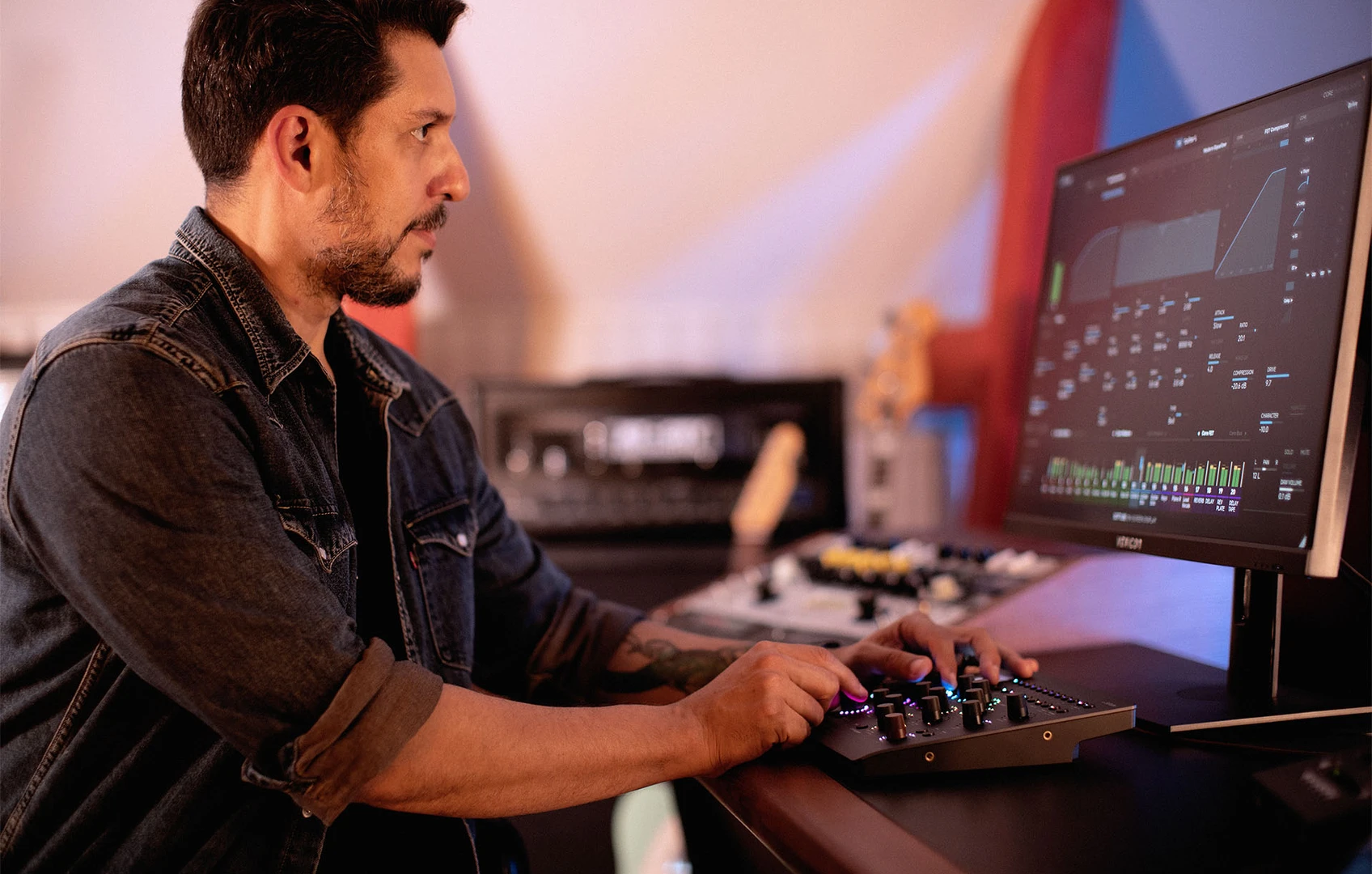
A smaller box with a bigger point
Softube’s Console 1 Compact arrives with a very specific promise: hands-on mixing for people whose studios are running out of desk, patience, or both. That pitch lands cleanly in 2026 because the modern home studio has become strangely efficient and strangely exhausting at the same time. We can edit anything, automate everything, recall everything, and still end a session feeling like we spent six hours filing paperwork with a snare drum open in another tab.
A compact control surface does not solve bad arrangements, weak balances, or indecisive ears. It can, however, change the way those decisions get made. That matters. The best argument for something like Console 1 Compact is not that it recreates a large-format desk in miniature. It is that it interrupts the habit of mixing by cursor alone.
Softube is clearly aiming at the producer who wants some physical contact with the mix but does not have room for a sprawling hardware footprint. That user is not hypothetical anymore. It is the default musician setup: laptop, interface, a pair of monitors if they fit, maybe one synth, maybe none, and a keyboard pushed halfway off the desk to make space for coffee and compromise.
Why trackpad mixing started to feel bad
Laptop mixing won because it is cheap, portable, and brutally capable. It also trained a generation of musicians to do tactile work through a flat rectangle. At first that tradeoff looked fine. Then sessions got denser, plugin chains got longer, and every simple move began to involve a tiny hunt for the right window, the right parameter, the right lane, the right modifier key.
That friction adds up in ways that are hard to measure on a spec sheet. It slows decisions. It encourages visual mixing because the screen is always shouting. It makes you reach for precision when what you may need is proportion. A fader under your hand and a knob with a fixed purpose can reduce that noise. Not because hardware is pure and software is corrupt, but because the body is good at repetition when the tool stays put.
This is why control surfaces keep returning, even after many musicians swear they are done with them. The appeal is not retro glamour. It is relief. If one hand can ride a level while the other mutes, solos, or flips focus without opening three more panels, the session feels less bureaucratic. You listen sooner.
The Compact part of the name is important here. Full-size desk fantasies are nice until they collide with an apartment. A smaller unit acknowledges the actual geometry of current music-making.
The home studio has changed shape
For years, a lot of studio gear was sold with an implied room attached: wide desk, acoustic treatment, dedicated monitor bridge, maybe a rack glowing proudly in the corner. The average musician does not live there. The average musician works in a bedroom, a spare corner, a shared office, or a room that becomes a studio only after the laptop opens.
That change in physical space has consequences for product design. Big, feature-stuffed hardware can be impressive and still miss the assignment. Musicians are not only asking what a device can do. They are asking whether it earns the square inches it occupies, whether setup feels fragile, whether it reduces or adds one more layer between idea and result.
A compact mixing controller fits this moment because it accepts a basic truth: the small studio is not a temporary compromise anymore. It is the center of the industry. Records, podcasts, cues, demos, release-ready singles, and client work all come out of these reduced spaces. Gear that behaves as if everyone has a control room from 2004 is solving the wrong problem.
Softube’s pitch to bring console-style handling into a desk-friendly format makes sense on that level alone. Even musicians who are not chasing vintage-console mythology may want a fixed physical place for core mix moves.
What these devices are actually good at
The useful question is not whether Console 1 Compact can do everything your DAW can do. It should not. When control surfaces try to become universal remotes for every possible function, they often become menu systems with knobs attached.
The real value is narrower and stronger. A good compact controller should make the common moves quicker, calmer, and easier to repeat: level balancing, broad tone shaping, dynamic adjustment, channel focus, and small performance-like gestures during mix passes. Those are the moves that benefit most from touch.
This is also where buyers should keep their expectations in line. A controller will not magically make you mix better. It may make it easier to notice that the vocal is too bright because you are listening instead of staring. It may help you commit to a low-mid cut because your hand already found the control and made the move before your brain opened a debate club. That is a real advantage, but it is still an advantage in workflow, not an automatic upgrade in taste.
For some users, that workflow shift is enough to justify the device. For others, especially people who already work fast with keyboard shortcuts and a mouse, the benefit may be modest. The point is fit, not doctrine.
The risk: one more thing to configure
Every control surface enters the same danger zone the minute it leaves the box: setup friction. Drivers, mappings, DAW integration, plugin compatibility, desk placement, USB clutter, power needs, and the small but persistent question of whether you will keep using it after the novelty burns off.
This is where experienced buyers get cautious, and rightly so. Music technology is full of devices that seem brilliant in week one and become expensive paperweights by month three because they interrupt the session more than they improve it. The calmer way to judge a product like this is to ask a few boring questions.
Does it reduce screen time during the tasks you do most often?
Can you leave it connected and ready?
Will it fit your desk without forcing your typing keyboard into exile?
Does the software side seem stable and intentional rather than sprawling?
If the answer to those questions is yes, compact hardware starts to look sensible. If the answer is no, even a clever controller can become one more object you move aside to reach the thing that actually works.
A quiet correction to plugin culture
There is another reason this launch feels timely. Mixing culture has spent years drifting toward abundance: more channels, more options, more visual feedback, more plugin windows, more versions of nearly the same move. That abundance is useful until it starts to thin out attention.
A hardware controller can act as a mild corrective. It narrows the field. It says: here are the controls, here is the channel, make the decision. That kind of limitation is often healthy, especially in small studios where the computer is also the recorder, editor, instrument rack, communication hub, and source of endless distraction.
Softube’s larger idea seems well aligned with that mood. Plenty of musicians do not want less power. They want fewer excuses to stop listening. Gear that supports that goal has a better shot than gear that merely adds another layer of possibility.
There is also a generational turn happening. A lot of younger producers came up entirely in the box and are now discovering that tactile control is not a luxury item for old studio romantics. It is a practical way to keep sessions from feeling abstract. Meanwhile, older engineers who once dismissed compact controllers as toys have become more open to them because the desk space and budget realities are different now.
Who this probably makes sense for
Console 1 Compact looks easiest to justify for three groups: laptop-first producers who mix their own work, small-studio songwriters who want less mouse dependence, and hybrid users who like software flexibility but still want one reliable physical anchor on the desk.
It may be less compelling for people who rarely mix beyond rough balances, for engineers already committed to a larger hardware control setup, or for anyone whose workspace changes daily and cannot support one more permanent object. Portability matters, but so does routine. A control surface becomes valuable when your hand learns where things live.
The broader takeaway is bigger than one product. We are in a period where music tools are getting judged less by headline feature count and more by whether they reduce fatigue. That is healthy. Musicians already have enough ways to do more. What many need is a better way to do the obvious things without turning every mix into office work.
Softube’s Console 1 Compact appears to understand that. The interesting part is not the nostalgia of console language. It is the modesty of the proposition. Give the hand something useful to do. Give the desk a device that earns its footprint. Give the ears a slightly better chance of getting the first vote.
In a cramped room, that can be the difference between endlessly adjusting a mix and actually finishing one.
Comments
No comments yet.