

 Written by Marvin Cavanaugh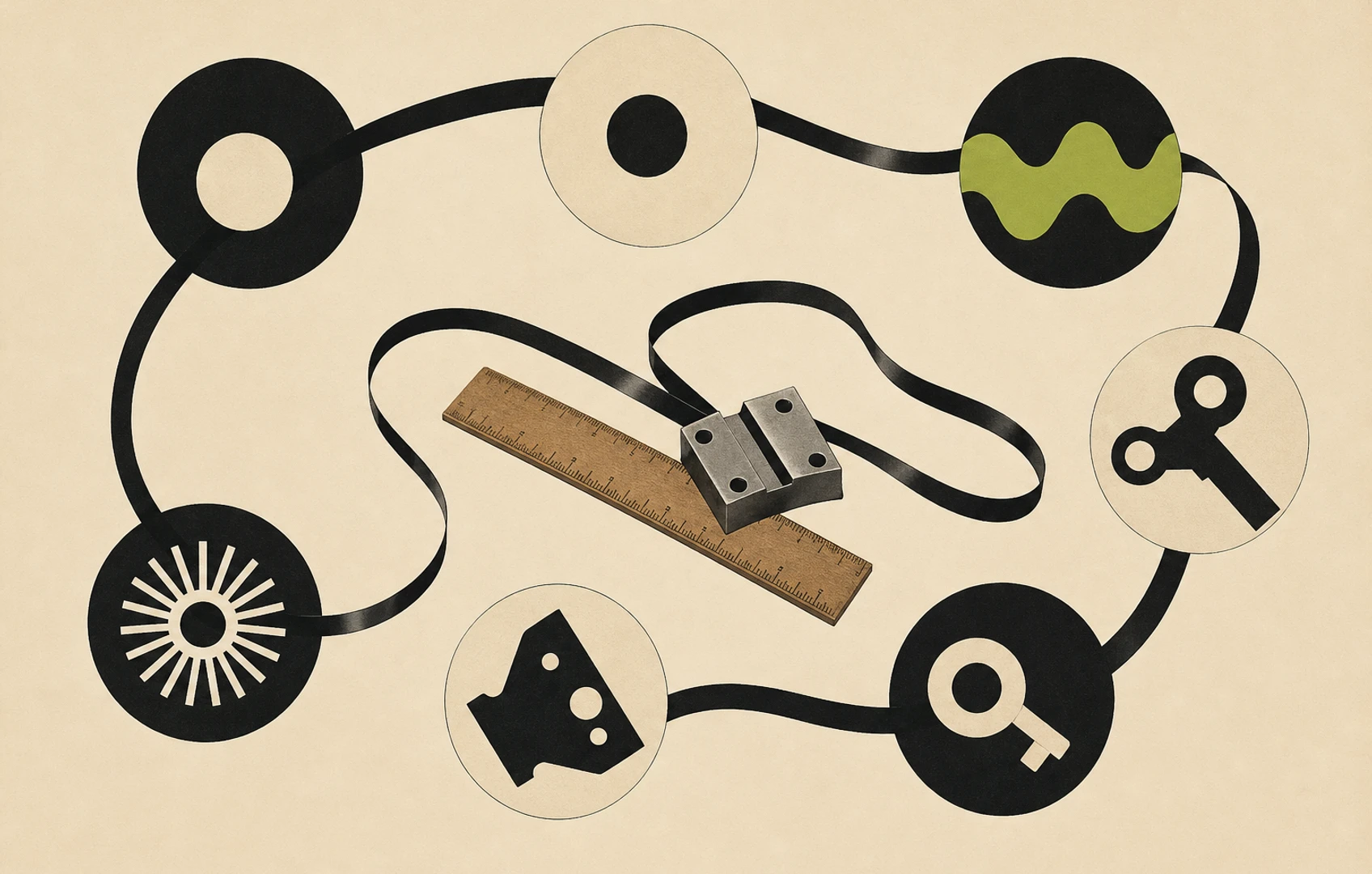
The Loop on the Workbench
Before Pink Floyd’s “Money” becomes a bass riff, it arrives as a small machine: clacks, tears, chimes, and cash-register punctuation cycling through an uneven pattern. A newly published MusicRadar reconstruction of the 1973 track returns attention to the least glamorous tool in the room. The method involved checking exact lengths of recorded tape with a ruler, then splicing them into a repeating seven-beat sequence.
The track began in Roger Waters’s garden shed, long before the loop became one of rock’s most recognizable openings. Beside a modern DAW, the process looks laborious. It also exposes a production habit that software can hide. A loop earns its place through proportion, sound choice, and an exit plan. Repetition alone does none of that work.
Nobody needs to reenact a 1973 tape room to learn from it. The useful sequence is simple: record a source, choose its duration, make the edit, and hear what the decision demands from the next part.
A Ruler Is a Timing Tool
On magnetic tape, time occupies distance. A longer strip plays longer. Matching a duration can involve matching a physical length, which is how a ruler ends up beside the recording equipment rather than back in a school desk.
That physical relationship made the “Money” loop’s meter tangible. Seven beats had to close cleanly. If the end met the beginning in the wrong place, the cycle announced the mistake every time it came around. The splice could be neat while the musical idea remained clumsy. Tape offered no intelligence about where the groove ought to land.
A modern timeline labels bars, beats, transients, and subdivisions before a note has been played. Those visual aids are excellent. They can also obscure the basic question the ruler forced into the open: exactly how much material belongs in this loop?
Try asking that before reaching for swing controls, random timing, or another sample layer. A weak cycle rarely needs decoration first. It needs better dimensions.
Seven Feels Better Than It Counts
“Money” is regularly introduced as the famous rock song in 7/4, which makes it sound like homework with a guitar solo attached. The opening effects and bass riff establish the lopsided cycle so confidently that the meter soon feels conversational. By the time the vocal arrives, the listener already knows where the pattern turns.
That is arrangement work. Odd meter becomes awkward when every instrument advertises the arithmetic. Here, the repeating sounds supply a fixed rail. The bass makes that rail musical, while the drums add weight and forward motion. The guitar solo’s move into 4/4 later creates the sensation of a road suddenly widening.
Producers experimenting with uneven phrases can borrow the underlying principle. Give the ear one stable element that explains the cycle. A short percussion phrase, bass pickup, room sound, or recurring breath can do the job. Let the surrounding parts respond rather than count aloud. An odd bar becomes convincing when the body predicts its return before the mind finishes calculating it.
The Grid Has Different Problems
A DAW can build a similar loop in minutes. Set the session to 7/4, place samples on the grid, quantize them, and duplicate the region. Accuracy is readily available. The scarce resource is attention.
The copy command makes it easy to keep a phrase running after it has finished its structural job. Sixteen repetitions become sixty-four with one drag. A loop that sounded hypnotic during construction can become wallpaper by the second verse. Random humanization may roughen its edges, but it cannot repair an unconsidered length or a weak accent pattern.
Software therefore needs deliberate stopping conditions. Duplicate a loop for a fixed section rather than across the whole song. Listen once with the waveform hidden. Mute it after the groove is established and check whether the other instruments can carry the pulse. If the rhythm only makes sense while the editor is visible, its internal cues need work.
Fix the duration and accents first. Timing variation and timbral movement can follow once the cycle stands on its own.
Try the Ruler Exercise
A modern ruler can be the selection readout at the top of a session. This short exercise recreates the useful pressure of physical editing while keeping every advantage of the DAW.
1. Record a handful of ordinary sounds. Keys, paper, a drawer latch, coins, and a muted guitar string are enough. Leave some room tone around each event instead of trimming everything immediately.
2. Choose an uneven cycle such as 5/4 or 7/4. Place the sounds by ear before applying quantization. Count afterward to verify the shape. This keeps the first decision connected to motion rather than screen geometry.
3. Consolidate one complete cycle into a single audio file. That rendered region becomes the splice. Keep the raw recordings on a muted track so revisions remain possible without cluttering the active decision.
4. Duplicate the loop through one defined section, then stop it. Build bass, drums, or chords against that section. Remove the guide temporarily and listen for any place where the groove loses its footing.
5. Restore the loop only where its color or timing cue earns space. A distinctive sound often has greater impact at the entrance, a transition, or the return of a refrain than beneath every bar.
The exercise does not require tape hiss, vintage processing, or artificial wobble. Its purpose is to make length consequential again.
Commit Without Worshipping Tape
Physical tape editing brings handling, alignment, wear, noise, and maintenance concerns along with its creative pressure. A reel-to-reel machine will not automatically make a loop musical. Plenty of dull repetition existed before the laptop.
Use the conveniences available now. Move a splice without reaching for adhesive. Change tempo without rebuilding the room. Undo the edit when it genuinely fails. Then add commitment where endless revision begins to drain attention.
Bounce a rhythmic bed once its proportions work. Print an effect return when the sound is settled. Freeze a temporary instrument so the session stops inviting microscopic adjustments. Set an endpoint for the section before duplicating anything. Keep the raw sources in a separate folder or muted playlist, narrowing the active decision while preserving a recovery path.
The older method matters because every cut fixed a relationship that the next musical part had to answer. Once the measured loop was running, the bass could not negotiate with a cloud of alternate versions.
The Part Automation Cannot Choose
The opening of “Money” catches the ear before a lyric arrives because its timbre and meter perform the same structural job. The loop enters, establishes the pulse, and eventually makes room for the band. That restraint is easy to miss when discussing the novelty of rulers and splicing blocks.
Modern software can reproduce timing with microscopic accuracy. It cannot decide when a device has taught the listener enough. That judgment still belongs to the person in the chair.
At the next session, draw a short region and treat its edges as physical. Choose the length, audition the seam, and decide where the repetition ends. Then stop dragging copies and let the bass or drums prove the rhythm. On screen, the ruler is a selection and the splice is a command. The loop still has to carry the room.
Comments
No comments yet.