

 Written by Avery Knox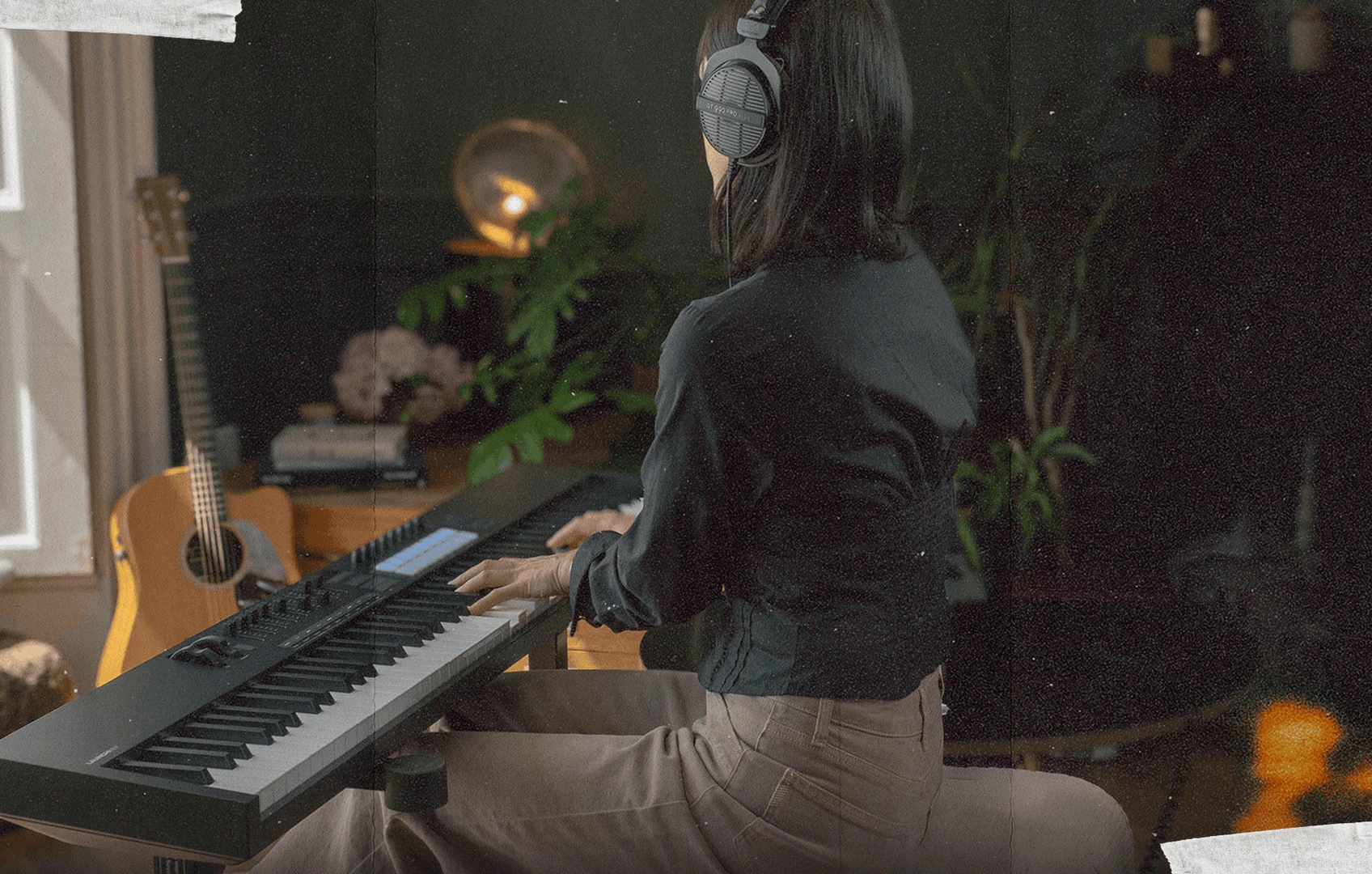
The keyboard gets longer because the session got wider
Novation has filled out its Launchkey MK4 range with an 88-key model, and on paper the move is obvious: more keys, semi-weighted action, nine faders, eight endless encoders, pads, transport, and the familiar pile of scale, chord, and arpeggiator functions that now come standard on ambitious MIDI controllers. But the interesting part is not the spec list. It is the kind of producer this keyboard assumes exists.
That person is no longer choosing between “piano keyboard” and “controller keyboard” as two separate identities. They are writing a string sketch in the morning, nudging drum buses after lunch, tracking a synth bass before dinner, and trying very hard not to break concentration every six minutes by grabbing the trackpad. The 88-key Launchkey MK4 arrives for that exact desk. It treats full range as a workflow decision, not a conservatory badge.
Full range used to signal seriousness
For years, 88 keys in a project studio carried a faint smell of aspiration. Sometimes that was justified. If you came from piano, fewer keys could feel like someone had sawed the edges off your thinking. Split points got cramped. Left-hand voicings became compromises. Big two-handed parts turned into a choreography of octave buttons and low-level annoyance.
But there was another version of the 88-key controller: a huge slab bought in a burst of optimism, then used mostly to trigger the same eight-bar loop in C minor while occupying half the room. A lot of smaller controllers won because they were easier to live with. They fit under shelves. They left space for a mouse, a notepad, a coffee ring, the little hardware synth that keeps surviving every desk reorganization.
What has changed is not just taste. The home studio itself has become more elastic. One keyboard is now expected to cover composition, arrangement, control, and enough performance feel to make virtual instruments less dead on arrival. The old split between “nice keyboard for playing” and “separate control surface for mixing” feels expensive in space, attention, and patience. An 88-key controller only makes sense in 2026 if it can behave like the center of the room rather than a very long input device.
The real pitch is fewer interruptions
This is where the Launchkey philosophy has generally been strongest, and why the 88-key version matters beyond simple range. Faders and endless encoders are not glamorous. They are anti-friction tools. They let you stay in that fragile stretch where a chord progression is still emotionally legible before the screen turns it into admin.
Nine faders suggest practical mixer duty: balancing stems, riding instrument groups, shaping sends, touching automation with something other than a cursor. Eight endless encoders make sense for plugin parameters, device macros, and the kind of repetitive adjustment that becomes weirdly exhausting when done with a mouse. Semi-weighted keys matter for a similar reason. They are not there to impersonate a grand piano for purists on a forum. They are there to slow your fingers down just enough that velocity, phrasing, and attack start carrying useful information into the DAW.
That sounds small until you compare sessions. On a light synth-action board, it is easy to overplay and then repair the performance later with editing. On a more resistant keybed, players often make slightly better decisions at the source. The MIDI lands with more shape. The quantize menu gets visited a little less. The headphone fatigue arrives a little later.
Chord modes are no longer beginner bait
One of the quieter changes in controller culture is that features once marketed as training wheels have become standard creative infrastructure. Scale modes, chord modes, and arpeggiators are not embarrassing anymore. They are arrangement accelerators.
That matters on an 88-key board because these features stop being little demo tricks and start becoming compositional tools across a larger physical map. You can hold a stable harmonic idea in one zone, test voicings in another, and keep enough range available for bass movement or top-line fragments without collapsing the whole thing into a cramped center strip.
For songwriters who build in layers, that physical room changes behavior. You are less likely to record a placeholder and promise yourself you will “play it properly later.” You can sketch the proper version sooner. For producers working with cinematic instruments, keyswitch-heavy libraries, or layered templates, extra range is not luxury. It is fewer mode changes, fewer workarounds, fewer moments where the instrument reminds you that it is really a spreadsheet with sounds.
There is also a psychological shift here. Modern MIDI helpers are less about correcting ignorance than preserving momentum. Nobody gets extra artistic credit for manually constructing every chord under deadline pressure while the vocal idea evaporates. The useful tool is the one that keeps the take moving.
The workstation era is over, but the desire never left
A lot of current controller design makes more sense if you remember what musicians liked about workstations in the first place. It was not only the sounds. It was the feeling of being inside one object that wanted the session to continue. You sat down, touched controls, and music happened before your browser had a chance to misbehave.
Laptop production broke that compact feeling into pieces. The trade was worth it: better editing, better recall, deeper libraries, easier collaboration. But every few years the market rediscovers the same ache. Musicians want software power with less software posture. They want to feel less like office workers formatting ideas.
The Launchkey 88 MK4 sits in that tension. It is not trying to be a workstation in the old sense. It still assumes the DAW is the brain. But it pushes the body of the process back into your hands. Long keybed, dedicated controls, playable shortcuts, immediate performance tools — all of it points toward a setup where the computer remains necessary without monopolizing your attention.
That is why this kind of release can feel more significant than a flashy synth engine announcement. The keyboard is not promising new sounds from nowhere. It is promising fewer breaks in thought. Anyone who has watched a good chorus flatten while they hunted for a plugin window knows that is not a minor promise.
Who this actually helps
The obvious audience is producers with piano vocabulary who have outgrown 49 or 61 keys. But the more revealing audience is the in-between musician: the person writing for singers, layering software instruments, mixing their own demos, and trying to keep one station flexible enough for all of it.
If your sessions regularly involve split-handed parts, wider voicings, orchestral patches, or detailed MIDI performances, an 88-key controller changes the shape of the workday. If your keyboard mostly triggers bass stabs, drum racks, and occasional hooks, the added footprint may still be too much of a trade. Bigger instruments impose domestic consequences. Desk depth matters. Chair position matters. The angle of your wrists at hour three matters.
That is the mature conversation around keyboards now. Not bigger equals better. Better fit equals better output. The strongest argument for the Launchkey 88 MK4 is that it appears to understand both sides: the need for playable range and the need for immediate control. It is trying to earn its size.
The modern main keyboard
A useful studio keyboard in 2026 has to do something difficult. It must feel inviting to play, competent at control, and boring in the best possible way once integrated into routine. Not flashy for a week. Dependable by month three, when the pads are dusty, the template is messy, and you are too deep in the arrangement to tolerate a single unnecessary detour.
That is the lens through which the Launchkey 88 MK4 looks timely. It completes a product line, yes. It also marks a broader expectation shift. The “main keyboard” in a small studio is no longer a symbolic centerpiece or a compromise object. It is a traffic manager for attention.
When these tools work, you notice something almost unromantic: fewer broken takes, fewer edits made out of convenience, fewer moments where your hands leave the instrument before the idea is finished. In a room full of plugins begging to impress you, that kind of restraint is a serious feature.
Comments
No comments yet.