

 Written by Cass Monroe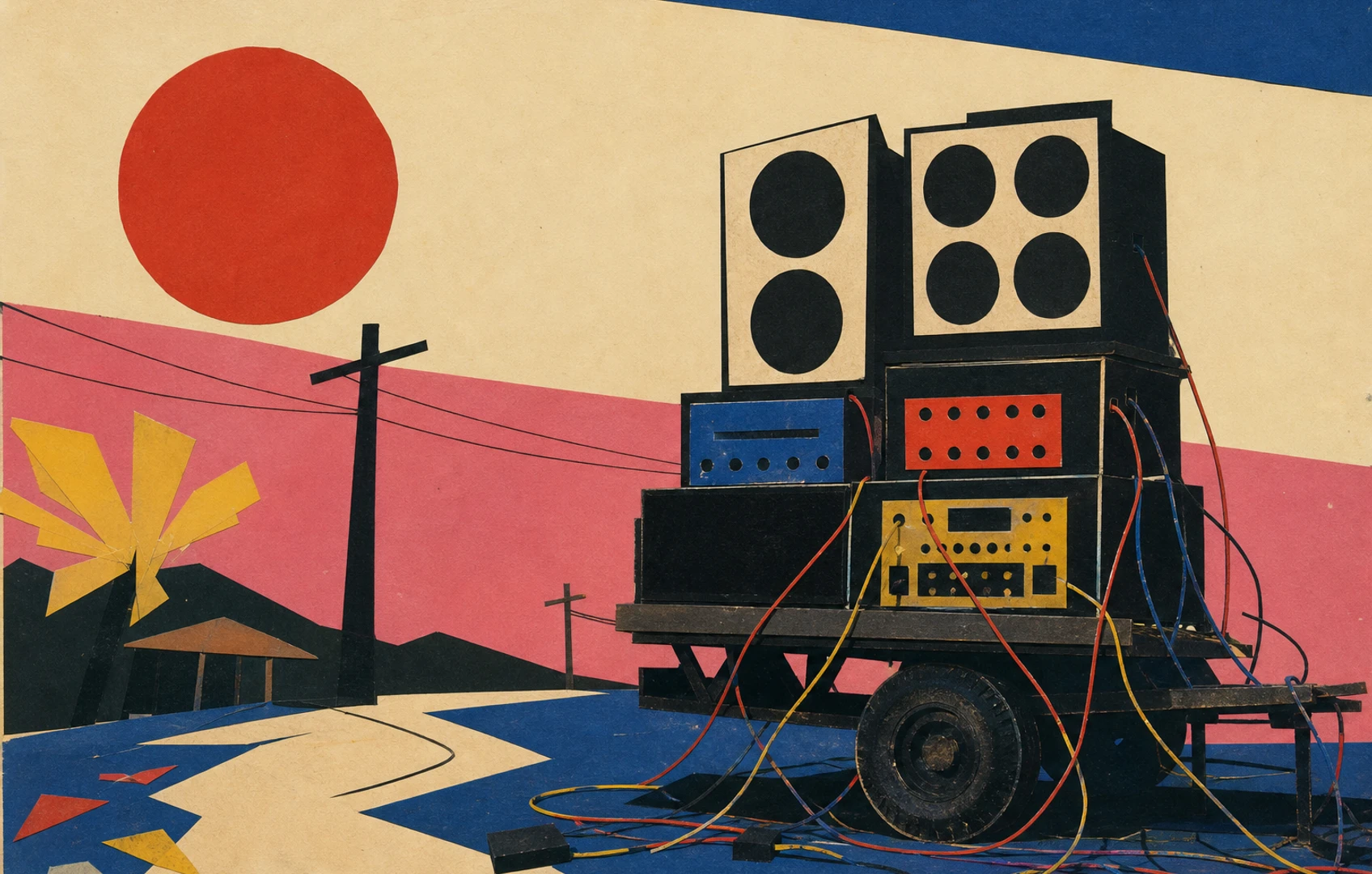
Speakers With a Past
Some music arrives as melody first. Some arrives as rhythm. Khun Narin’s story arrives as hardware.
The striking detail in the latest attention around the group is not only the blend of Thai folk forms with a blasted, trancey, garage-adjacent force. It is the physical route that force travels through: old loudspeakers, improvised systems, mobile rigs assembled from available parts, and a practical understanding that amplification is never neutral. A speaker cabinet is a box with a memory. A horn is a shape that tells sound how to leave the body.
That is what makes Khun Narin such a rich Audio Chronicle subject. This is not just a band story and not merely a regional-curio story for crate-diggers who enjoy saying they heard the weird thing first. It is a story about what happens when audio infrastructure gets folded back into community life. Objects built for one era and one power structure are stripped for parts, rewired, and made to serve dancing, procession, ceremony, and local joy.
When Loudness Changes the Music
Traditional music does not stay traditional once you change the system that carries it. That sounds obvious, but we often talk about preservation as if songs pass through gear untouched. They do not. Microphones reshape distance. Amplifiers reward certain attacks. Speakers exaggerate some frequencies, smear others, and turn a phrase into either a caress or a command.
Khun Narin’s sound has fascinated listeners far beyond Thailand because it seems to hold two kinds of motion at once. One is cyclical and rooted, the kind of repetition that belongs to village playing, dancing, and communal time. The other is mechanical and propulsive, the sensation of electricity pushing the music outward until it starts to resemble psych rock, parade music, and homemade public-address futurism all at once.
That transformation matters because volume is never only volume. Once folk music is projected through a robust, portable system, it becomes spatially different. It reaches farther down the road. It gathers a crowd differently. It competes with engines, weather, chatter, and open air. Players respond by leaning into repetition, attack, sustain, and pulse. The music thickens around the needs of the rig.
In other words, amplification becomes part of the composition, even when nobody writes it down that way.
The Afterlife of Military Audio
The most haunting detail in this story is the reuse of former US military loudspeakers. That material history gives the sound an unsettling charge. Audio gear is often discussed as if it were cleanly separated from politics, but it rarely is. Speakers travel through wars, state budgets, surplus markets, repair shops, garages, and back roads before they arrive at a celebration.
There is something deeply moving about that conversion. Not redemptive in a neat, cinematic sense. The metal does not forget where it came from. The horn flare still carries the design logic of command and projection. But once those parts are claimed by musicians and local builders, their job changes. They no longer transmit authority from above. They throw music sideways into public space.
Cassette culture did this with duplication. Dub did it with versions. Street systems all over the world have done it with bass bins, truck batteries, and patched-together crossovers. Khun Narin belongs in that wider family of scenes where people do not wait for ideal tools. They inherit damaged, strange, or mismatched ones and develop a style that makes those limitations audible.
That is one reason the sound feels so alive. It was not optimized into blandness.
A Mobile Rig Is a Social Machine
Portable sound changes behavior. Anyone who has spent time around a procession rig, a DIY DJ cart, or a battery-powered street setup knows this immediately. The system is not furniture. It moves, and because it moves, the crowd moves with it. Music stops being a destination and becomes a temporary weather pattern.
Khun Narin’s setup carries that same social logic. Even if a listener first encounters the band through recordings online, the underlying design principle is public and mobile. The rig is built for roads, gatherings, local circulation, and the rough acoustics of open environments. That gives the music a different kind of edge than a studio-born act later adapted for the stage.
You can hear this in the way many mobile systems favor directness over polish. They need strong midrange information. They need rhythms that survive wind and distance. They need phrasing that remains legible when the sound reflects off concrete, trees, shopfronts, or passing vehicles. A highly perfected hi-fi balance would almost miss the point. The goal is not a pristine image suspended between two monitors. The goal is contact.
That distinction is useful far beyond this one band. It reminds us that a lot of globally loved music was shaped not by ideal listening rooms but by compromised, ingenious systems built for public life.
Why the Internet Hears Psychedelia Here
Western listeners often reach for familiar tags when confronted with a local sound that scrambles their filing system. Psychedelic. Prog. Freakout. Drone. Those words are not useless, but they can flatten the engineering reality that makes the music feel so disorienting in the first place.
What many people are hearing as psychedelia may also be the audible signature of projection — sustained tones stretched by outdoor reverberation, repetition intensified by horn-loaded force, distortion introduced by practical gain staging, and ensemble interplay arranged around what the rig can carry. The trance is partly musical language and partly acoustic consequence.
That is where the Khun Narin story gets especially interesting. It asks the listener to hear genre less as a sealed identity and more as a byproduct of tools, routes, and listening conditions. A melody associated with one tradition can feel radically different once it is pushed through another delivery system. The resulting hybrid is not fake, and it is not a novelty. It is what culture sounds like when equipment enters the bloodstream.
For readers used to thinking of gear as a shopping category, this is a welcome correction. Sometimes the most important audio story is not a new box. It is an old box used hard enough to make a new form.
The Craft Hidden Inside “Homemade”
Homemade gear is often romanticized in a vague way, as if improvisation were magic and roughness were automatically authentic. The real thing is better than that because it is more specific. Homemade systems involve maintenance, repair, compromise, and a close reading of materials. Someone has to know which driver still works, which cabinet can survive transport, which connection fails when jostled, which buzz can be tolerated, and which one means the night is about to end early.
That kind of knowledge rarely receives the same cultural prestige as boutique audio design, though it deserves a place beside it. There is design intelligence in making a system field-ready with limited parts. There is acoustic judgment in choosing projection over refinement when the setting demands it. There is also a tactile musicianship to playing with a rig that does not hide its friction.
Khun Narin’s appeal, then, is not merely that the music sounds unusual to outsiders. It is that the whole apparatus reveals a practical art of sound. Wheels, boxes, horns, wiring, and local repair culture become part of the performance grammar. The rig is not backstage support. It is one of the instruments.
Listening for the Box, Not Just the Song
The freshest thing about this moment of attention around Khun Narin is the invitation to listen materially. Hear the line, yes, but also hear the cabinet. Hear how projection alters phrasing. Hear how a portable system changes what counts as groove. Hear how a piece of surplus hardware can carry one history in its metal and another in its present use.
That kind of listening opens doors. It makes street rigs, wedding systems, procession carts, community PAs, and homemade stacks feel central rather than peripheral to music history. It also loosens the old hierarchy that puts expensive studio precision at the top and everything rougher beneath it. Plenty of essential music has been built around pressure, leakage, grit, and outdoor survival.
Khun Narin’s sound does not ask for museum respect. It asks for attention to the chain. Song to player, player to amp, amp to horn, horn to road, road to crowd. By the time the music reaches the listener, the machinery has already joined the band.
Comments
No comments yet.