

 Written by Nico Delray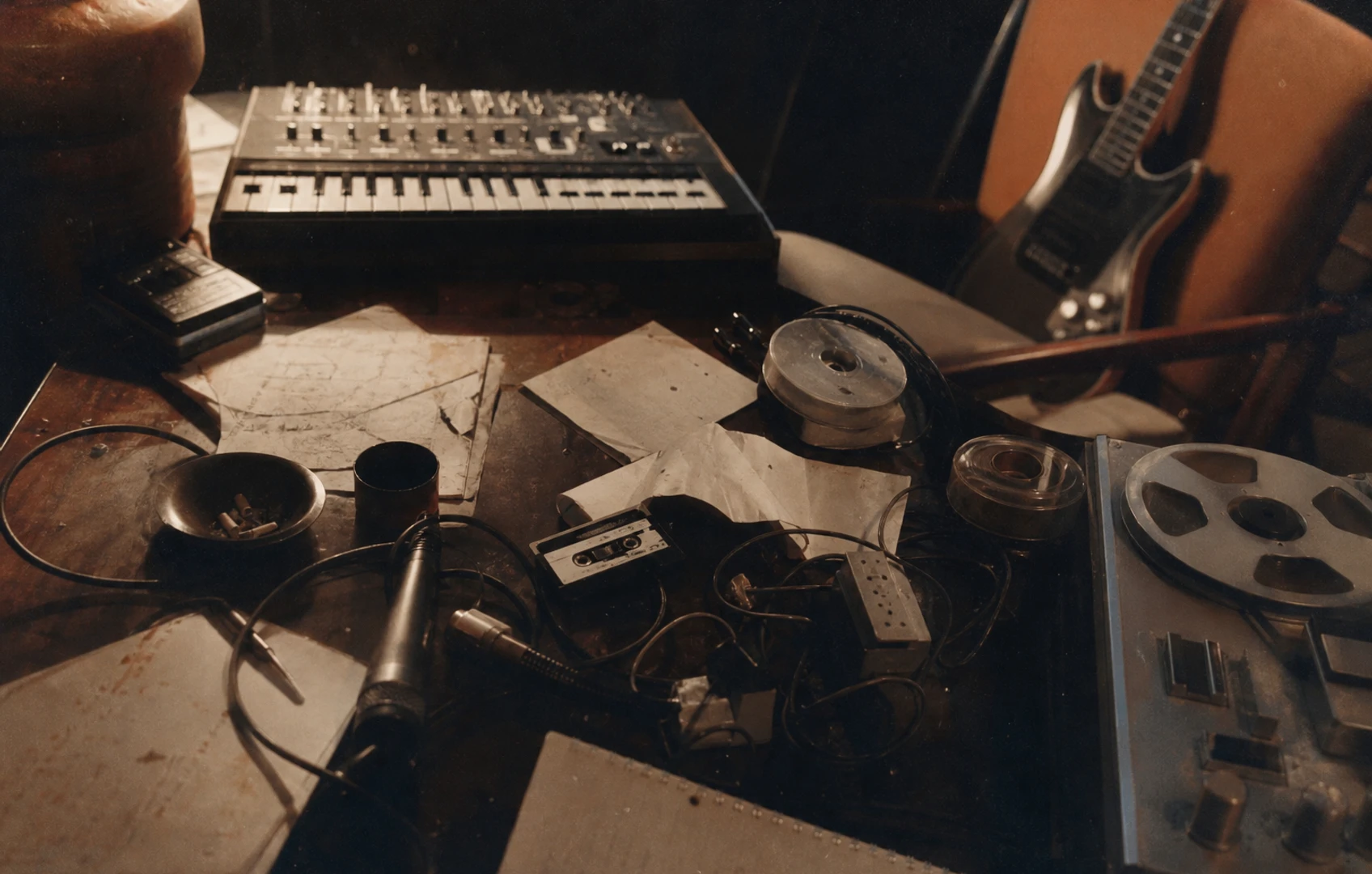
The room before the take
David Byrne’s latest comments about working with Brian Eno are useful partly because they are so unglamorous. The detail that sticks is not some mystical revelation about genius. It is Eno hearing a half-formed idea and responding with momentum instead of caution. Byrne described a collaborator who did not freeze the room by demanding proof too early. For anybody who has ever watched a recording session die under the weight of one raised eyebrow, that is instantly recognizable.
This matters now because plenty of musicians have more tools than ever and less ease using them. Home studios are fast, cheap by historical standards, and absurdly capable. They are also full of little traps. Every screen invites editing before playing. Every plugin window asks for a verdict. Every session can become a quality-control meeting before a song has even decided what kind of song it is.
Byrne’s Eno anecdote lands right in that sore spot. It points to a studio habit that is less about taste than about sequence. Encouragement first. Sorting later. The order changes everything.
The fastest way to kill a session
Most bad sessions do not collapse because the mic was wrong or the preamp lacked magic. They collapse because the room starts judging too soon. Somebody plays a part that is 60 percent there, maybe 30 percent there, and instead of following the energy, the conversation turns into a problem list. Timing. Tone. Genre fit. Whether it is too weird. Whether it is weird enough. Whether somebody else already did it better in 1979.
That is how musicians end up circling the same eight bars for two hours with worse posture and dimmer eyes.
The player-facing version of Byrne’s point is simple: if you want better takes, protect the moment before the take knows what it is. A lot of good parts arrive with extra noise on them. A clumsy entrance. A wrong patch. Too much fuzz. A rhythm that feels slightly late until the drums meet it. If the room treats every early pass like a final exam, those parts never get a second swing.
This is not an argument against standards. It is an argument for timing. Tracking and judging are different jobs. Good studios separate them, even when the studio is a desk in a spare bedroom and the producer is also the guitarist, engineer, and person making coffee.
What “playground” means when cables are involved
The word playground can sound soft and vague, the kind of thing people say right before wasting an afternoon. In practice, it is physical. It means setting up a room so ideas can be tried before they are explained.
For guitar players, that might mean leaving one amp or modeler patch intentionally unruly instead of optimizing every preset into the same polite rectangle. For synth players, it might mean keeping one hardware path or software template ready for abuse: too much resonance, clocked delay doing something rude, modulation deep enough to create accidents. For vocal sessions, it can mean printing a strange monitor chain that changes the performance even if you never keep the effect.
The common thread is response. A playground setup answers back fast. It does not make you menu-dive for ten minutes to test a hunch. It does not require a committee meeting to move a mic six inches. It does not punish curiosity with friction.
That is the practical lesson hidden inside decades of romantic chatter about experimental records. The people making them often had a better feel for session flow than for mythology. They knew that if a player has to stop feeling in order to start operating, the part usually gets smaller.
The home-studio mistake: preserving options forever
Modern recording culture loves optionality. Keep the DI. Keep the dry vocal. Save three versions. Duplicate the playlist. Print nothing. Decide later. Some of that is smart. Some of it is fear wearing a lab coat.
A playful room does not mean a careless room, but it does mean committing often enough that sound becomes part of the writing. Byrne and Eno are a useful shorthand here because their partnership is often remembered for ideas, not for the very material way ideas become records. Texture is not decoration after the song is done. Texture can be the thing that tells the player how to play.
You can hear the difference between a session built around endless reversibility and one built around invitation. In the first kind, everybody behaves like they are trying not to make a mistake. In the second, they are trying to discover what the track wants from their hands.
If you work at home, one of the easiest upgrades is to create one lane in your process where “later” is not allowed. Print the mangled delay return. Bounce the weird room mic crush. Keep the first pass with the bad edge if it carries the right body language. Give yourself something to react to besides a clean, undecided file.
Encouragement is a studio tool
Musicians tend to talk about creativity as if it lives above the hardware, but the social feel of a session is as real as any compressor. Byrne’s description of Eno is valuable because it frames encouragement as an active production move, not a personality trait.
A producer, bandmate, or self-producing artist can change the output of a room by choosing which sentence comes first. “That could be something” keeps signal moving. “I’m not sure it works” might be accurate, but accuracy is not always useful in minute twelve.
This is especially true for players who are not natural overperformers. Plenty of great musicians need one pass to locate the part, one pass to trust it, and one pass to actually deliver it. If the room treats the locating pass as evidence for the prosecution, the trust pass never arrives.
Touring players know this instinctively. At rehearsal, you do not stop every run to discuss whether the chorus guitar is culturally legible. You keep the band moving until the song starts pushing back in a clear way. The studio deserves some of that same practicality. Keep the line live. Fix what is truly broken. Leave the rest alone until the music gives you a stronger reason.
How to build a less judgmental setup this week
You do not need a famous collaborator or a room full of vintage gear to borrow this mindset. You need a few decisions that reduce hesitation.
First, make a sketch template that opens ready to record, not ready to organize. One vocal track, one instrument track, one rough drum source, one effect send that is a little too alive. The point is speed.
Second, keep one sound in your setup that feels slightly dangerous. Not unusable. Just not pre-approved. A pedal that spits a little. A plugin chain that smears transients. A cheap mic placed where it should not flatter anything. That sound becomes a door.
Third, split writing time from cleanup time. If you are still generating parts, do not start naming every track and correcting every transient. Administrative virtue has ended many promising afternoons.
Fourth, if you work with other people, agree on language. During idea stage, nobody gets to say “wrong” when they mean “unfinished.” That one swap can save a session.
Finally, leave evidence. Notes on paper. Voice memos. Marker on tape. A rough bounce sent before you get embarrassed and delete it. Play likes traces. If you sterilize the workspace after every attempt, tomorrow starts colder.
Why this old lesson feels current again
Byrne talking about Eno hits a nerve now because musicians are dealing with a strange split. The tools promise freedom, while the workflows often produce caution. We can edit endlessly, compare instantly, and audition alternatives until the track feels like it was assembled under surveillance.
The antidote is not nostalgia for some supposedly purer era. Old studios could be rigid, expensive, and brutally hierarchical. The useful part worth stealing is narrower: a sense that experimentation was part of the labor, not a cute extra after the serious work was done.
That is why this story stays alive. It gives players and producers a concrete reminder that the room has a mood, and the mood affects the take. A studio can be tidy, professional, and dead on arrival. It can also be modest, slightly messy, and full of forward motion.
The next time a half-baked part shows up and your first instinct is to tighten the screws immediately, try the Byrne-into-Eno move instead. Keep rolling. Move the mic. Print the odd version. Let the mistake show you its use before you escort it out of the building. Sometimes the song is sitting right there, still wearing its work clothes.
Comments
No comments yet.