

 Written by Cass Monroe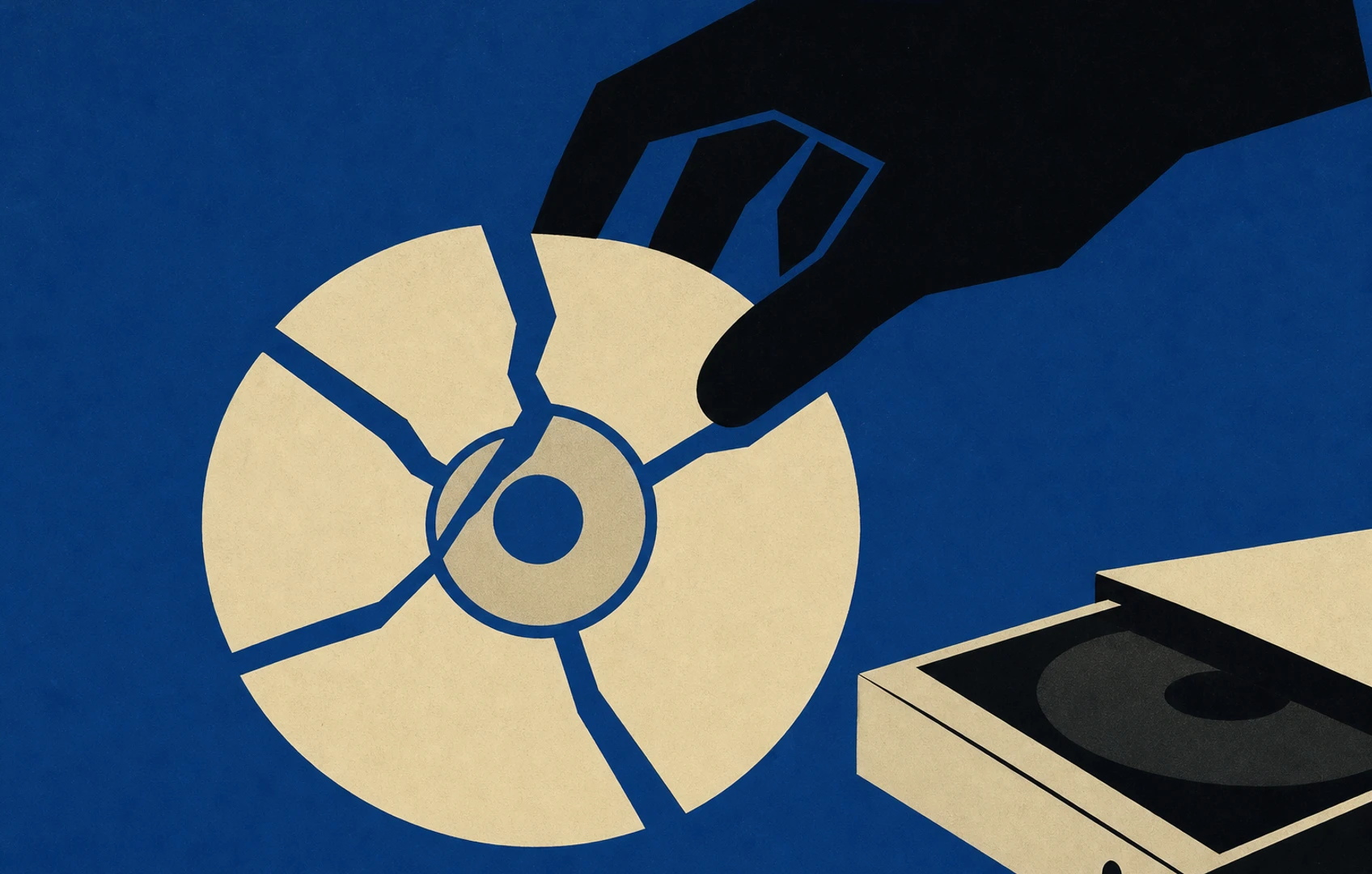
The silver-disc uptick
The compact disc has spent years tucked behind vinyl’s louder revival, a silver afterthought in a cracked case. NME reports that US CD sales grew by 16 percent during the first half of 2026, compared with vinyl’s 2.4 percent increase. Those percentages measure momentum. They leave total category size, revenue, and unit volume unresolved, since a smaller base can produce a larger gain. Even with that caveat, the gap makes the once-unfashionable disc worth examining again.
Stereogum highlighted the stranger companion finding: half of Gen Z and millennial CD buyers reportedly do not own a CD player. Listening and collecting are sharing the same sales line. Some buyers may be acquiring an album they can already hear through streaming while keeping the disc as a fan object, a distinct edition, or a promise to assemble the hardware later.
Take a CD by its edges and tilt it. Light fractures into violet and green. The center hub yields with a small springy click, then the lid closes with a sharper one. Its industrial promise remains modest: a standardized album package, compact enough for an ordinary shelf, with playback that begins at the press of a button.
Designed for ordinary rooms
Sales reports cannot identify a single motive, but the design offers clues. A traditional turntable setup needs a stable surface, a clean stylus, and a phono stage somewhere in the chain. A home CD deck needs power and a line-level connection. A portable player can feed headphones directly. Playback asks for little user calibration.
The jewel case is one of consumer audio’s most honestly imperfect containers. Hinges snap. Hub teeth break. Clear plastic collects scratches immediately. Its faults occur at visible mechanical points, and a standard shell can usually be replaced while preserving the booklet and rear inlay. The music carrier remains separate from the wounded packaging.
Vinyl still gives cover art room to breathe, while a cassette slips more easily into a pocket. CD occupies the useful middle. It has space for a booklet, plays an album continuously, and leaves a relatively small footprint. A short row of narrow spines can sit beside the amplifier while the top surface stays clear.
The collector without a player
One plausible sequence explains the player gap. Discovery begins on a phone, the physical edition arrives later, and the hardware comes last. A listener can know every beat of an album before touching its packaging. The eventual disc adds paper texture, production credits, lyrics when included, and edition-specific artwork to something previously experienced as a thumbnail.
That purchase can still make sense without immediate playback. The package functions as a durable receipt of fandom with a standardized audio source inside. A compatible machine can arrive later. Until then, the owner still has the booklet, the cover and an object that cannot disappear because a streaming license changed.
Collectors benefit from deciding what job each edition performs. A listening copy needs a secure hub and a clean playing surface. A packaging-focused edition may be valued for its insert or unusual construction. When near-identical variants pile up, the useful object starts resembling inventory. If sound differences matter, noting catalog and matrix information helps distinguish editions that look nearly the same.
The missing machine
Hardware is the weak link. Optical drives have vanished from many new laptops and cars, two places that once made CD playback automatic. A new collector may encounter the disc as merchandise before meeting a tray-loading machine.
Several routes remain. A standalone deck is the direct hi-fi option. Many DVD and Blu-ray players accept audio CDs, though model support should be checked. A compatible external computer drive can play or import tracks with suitable software. Portable players provide a direct headphone path, with widely varying controls and output.
When assessing an older player, concentrate on its moving parts:
- Cycle the tray several times. Hesitation may point to an aged belt, stiff grease, or a worn gear.
- Use a clean, known-good disc and seek to early, middle, and final tracks. Repeated hunting deserves attention.
- Match the outputs to the system. Analog RCA feeds a line input, while optical or coaxial digital requires a compatible DAC.
- Check the display and front-panel controls. A missing remote matters more when basic track functions are absent from the player itself.
Laser assemblies and mechanisms age, and replacement parts vary by model. A brushed metal faceplate cannot compensate for a drive that refuses the final tracks. Mechanical health should lead the inspection.
The sound inside the plastic
The familiar audio-CD specification uses 16-bit linear PCM sampled at 44.1 kHz. Inside a player, the transport reads the encoded pattern while error correction handles minor read problems. The digital-to-analog converter then turns those numbers into an electrical signal. Players with digital outputs allow an external converter to perform that final step.
Mastering complicates format arguments. CD and vinyl editions of the same album may use different source masters, limiting, equalization, or level choices. A brighter or louder disc can reflect those decisions rather than an inherent property of optical playback. Useful comparisons require matched volume and, whenever possible, editions known to share mastering.
Condition also has audible consequences. Hold discs by the edge or center hole, return them to cases, and remove dust with a soft lint-free cloth using straight strokes from the center outward. Deep label-side gouges deserve particular attention because the data layer sits closer to the printed face than the clear reading surface.
With a healthy disc and transport, track starts remain precise and the album runs without a side change. The machine recedes to a faint whirr behind the music.
Put the shelf into motion
A practical CD collection can begin with albums already played frequently. Pull a small group from storage, replace broken cases, confirm that booklets are present, and listen through each disc. This quickly separates a working music library from a stack accumulated through habit.
When examining used discs, angle the playing surface toward a diffuse light. Fine marks may be cosmetic, while deeper scratches deserve caution. Inspect the center hub for cracks and make sure the case teeth hold the disc without forcing it. Store cases upright, away from sustained heat and direct sunlight.
Placement matters too. A player buried beneath rarely used equipment adds friction to every session. Keep its tray reachable, leave room for the lid or drawer to move, and put the discs close enough that choosing one feels easier than searching for it on a phone.
The next useful signal will come from hardware: optical drives returning to homes, old decks receiving service, and new releases arriving with booklets worth opening. For now, the shelf may hold both habits. Some cases stay immaculate. Others gather faint thumbprints around the center hole beside a tray that closes with a patient plastic click.
Comments
No comments yet.