

 Written by Levi Torres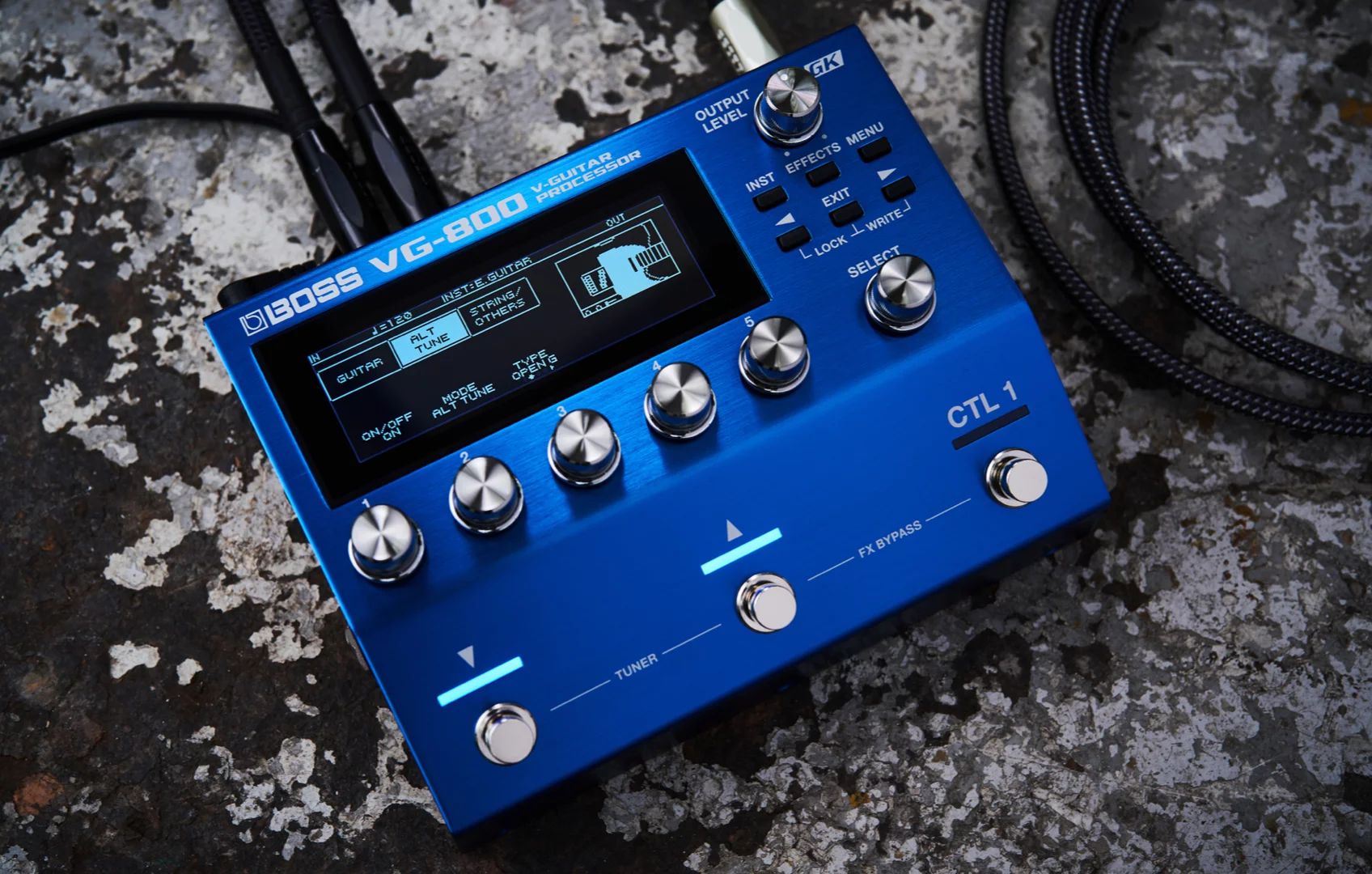
I used to roll my eyes at guitar modeling gear.
You know the type — endless menus, plasticky amp tones, a user interface that feels like setting a microwave. Every few years a new box drops claiming to "replace your entire rig," and every few years I plug in and feel nothing.
Then I met the Boss VG-800, and I felt… curious. Then surprised. Then a little freaked out.
Because this one? This one’s different.
First Impressions: More Stompbox Than Space Shuttle
The VG-800 looks unassuming — like a sturdy pedalboard processor with a crisp screen and familiar Boss footswitches. But under the hood, it’s packing some serious Frankenstein tech.
At its core, it’s a guitar modeling processor with full MIDI integration, powered by Boss’s new GK (divided pickup) technology. Plug in a GK-compatible guitar, and the VG-800 doesn’t just model amps — it models your instrumentitself. Body shape, pickup type, tuning — even string behavior.
It’s like building a custom Frankenstein guitar… from inside a box the size of a laptop.
Sound: Modeling That Doesn’t Feel Like Modeling
This is where the VG-800 earns its stripes.
Instead of bland digital approximations, it lets you sculpt your tone starting from the guitar up — literally. Want a Tele body with a humbucker in the neck, tuned a half-step down, running through a JC-120 into a stereo chorus? Done. Want a 12-string acoustic with alternate tunings and weird synth textures under the hood? Also done.
And it doesn’t sound like a modeling box. It sounds alive. Dynamic. Responsive. I caught myself digging in and hearing the tone react like a real amp. There’s that subtle sag, that harmonic bloom — stuff you can’t fake with IRs and EQ curves alone.
Does it replace a $3,000 boutique head? No. But it does replace the urge to bring three guitars, two amps, and a chain of pedals to your next session.
Performance Features: Built for the Brave (or the Busy)
This thing’s a godsend for live players. You can assign custom tunings per patch, meaning one song’s in drop C, the next is in Nashville tuning, and you don’t even have to bend over. The patch switching is seamless — no audio gaps, no digital hiccups. Just clean, instant transitions.
There’s also deep MIDI control, so if you’re running backing tracks, syncing visuals, or live-looping, the VG-800 becomes the brain. It’s basically a smart guitar command center.
And the effects? Very Boss. Very usable. Not earth-shattering, but rock-solid. Reverbs are lush, drives are tight, and the modulation is delightfully weird when you want it to be.
Editing & Interface: Almost Too Deep
If there’s a catch, it’s this: you can get lost in it. The VG-800 is powerful, but it’s menu-heavy. Editing patches from the front panel is doable, but slow. You’ll want to use the software editor for serious building — and even then, there’s a learning curve.
But once you wrap your head around the logic, it’s addicting. I spent an entire night crafting a guitar tone that sounded like a banjo run through a tape machine falling down the stairs. Not sure I’ll ever use it — but I could. And that’s the point.
Is It for You? Let’s Break It Down.
The VG-800 is not for traditionalists. If your idea of tone starts and ends with tubes, wood, and pure signal path minimalism — walk on. This ain’t your rig.
But if you’re:
- A multi-instrumentalist trying to simplify your live rig
- A producer wanting flexible tones without 12 guitars in the studio
- A composer who needs alternate tunings, synth layers, or MIDI madness on demand
Then yeah. The VG-800 is a beast. A smart, deep, incredibly capable beast.
Final Verdict
The Boss VG-800 doesn’t try to replace your guitar rig — it tries to reimagine it. And shockingly, it succeeds.
It’s not perfect. It’s not plug-and-play. But it’s powerful, musical, and weird in the best way — and in a world of gear that all starts to blur together, that’s enough to make it worth listening to.
Comments
No comments yet.